Are you preparing for the AZ-900 exam and feeling overwhelmed? Moreover, if so, you’re in the right place! In fact, this blog post covers AZ-900 exam questions and answers 2025–2026 with over 100 practice questions to help beginners and job-seekers master the Microsoft Azure Fundamentals certification. In particular, the AZ-900 (Azure Fundamentals) exam is a popular entry point for anyone interested in cloud computing. Moreover, using practice questions with detailed explanations can boost your confidence by identifying knowledge gaps.
What is the AZ-900 Azure Fundamentals Exam?
First, let’s clarify what the AZ-900 exam is. Additionally, it tests your basic understanding of cloud concepts and core Azure services. Specifically, Microsoft describes it as demonstrating foundational knowledge of cloud concepts in general and Azure in particular. Furthermore, this certification is often the first step in a cloud career, serving as a common starting point for future Azure certifications.
For starters, the AZ-900 exam is designed to be accessible for beginners. For instance, Microsoft’s official exam page notes you have 45 minutes to complete the assessment. In practice, during that time, you might see around 40–60 questions (the exact number varies). Typically, each question could be multiple-choice, true/false, or a simple scenario. Importantly, the exam is not intended to be extremely difficult; it covers high-level concepts without expecting deep technical expertise. Indeed, it’s more about understanding concepts than solving complex problems.
Who Should Take AZ-900?
Typically, it’s for beginners and early-career professionals. In fact, you don’t need to be a coder to take AZ-900. For example, if you have an IT background—such as infrastructure management, database administration, or software development—you already have skills that align well with the content. However, even people in non-technical roles (like marketing or finance) often take AZ-900 to demonstrate cloud knowledge. Indeed, many hiring managers view AZ-900 certification as proof of foundational cloud proficiency.
Key Topics Covered on AZ-900
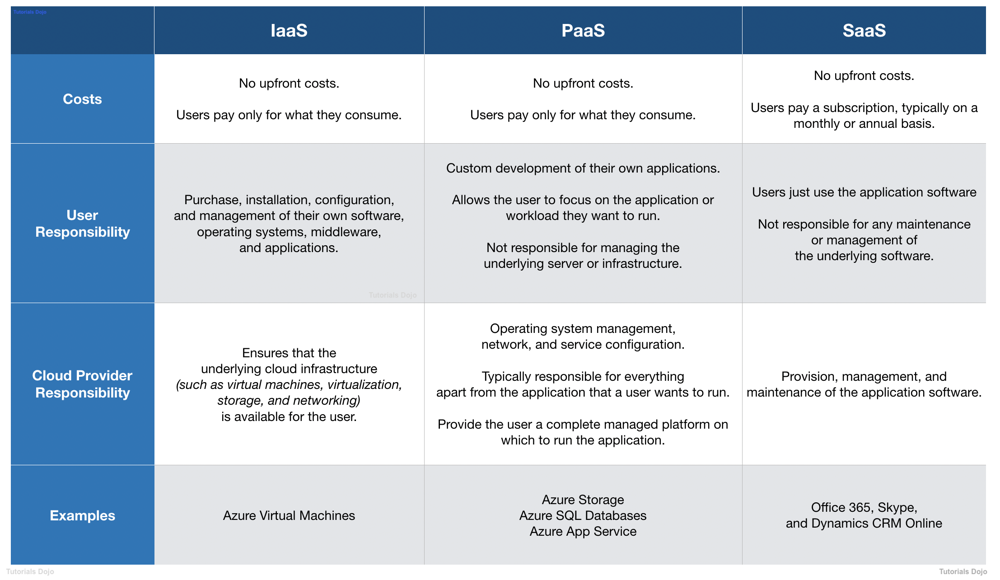
The cloud service models (IaaS, PaaS, SaaS) illustrate different levels of responsibility for the user vs provider. Understanding these cloud models is a fundamental part of AZ-900’s cloud concepts. Microsoft explicitly lists these service models in the exam objectives. For example, these three categories align with Microsoft’s exam objectives.
For example, Microsoft outlines three main topic areas for AZ-900: cloud concepts, Azure architecture and core services, and management and governance. To break this down:
- Cloud Concepts (25–30%): You’ll define cloud computing, explain benefits (scalability, reliability, security), and compare models (public, private, hybrid clouds). For example, you should know what IaaS, PaaS, and SaaS mean and when to use each. A study guide notes that IaaS requires more user control (like OS patching), whereas PaaS abstracts much of that away. Familiarity with consumption-based pricing and the shared responsibility model is also important.
- Azure Core Services (35–40%): This area tests your knowledge of Azure’s products. For instance, you should know what an Azure Virtual Machine (VM) is, what Azure Blob Storage does, and how virtual networks work. You should understand basic Azure constructs like resource groups, subscriptions, and regions (including availability zones). In short, know the purpose of key services like web apps, containers, SQL databases, and more.
- Azure Management and Governance (30–35%): This covers how to manage Azure resources. You should be familiar with the Azure portal and tools like Cloud Shell, CLI, and PowerShell. Topics include Azure Advisor, cost management (pricing calculator, budgets, tags), as well as security/governance tools like Azure Policy, role-based access control (RBAC), and Microsoft Defender for Cloud. In short, expect questions on monitoring, billing, and compliance features.
For instance, these three categories align with Microsoft’s exam objectives. By studying practice questions for each area, you’ll cover the full range of topics the AZ-900 exam expects.
Types of AZ-900 Practice Questions (and Difficulty)
In fact, understanding question types is crucial. For example, the AZ-900 exam uses a variety of formats, such as multiple choice (single answer), multiple answers, true/false, drag-and-drop, and simple case scenarios. Our practice set mirrors this mix. Here is a table summarizing common question types and their typical difficulty:
| Question Type | Typical Difficulty |
|---|---|
| Multiple Choice (single answer) | Basic – straightforward knowledge check |
| Multiple Choice (multiple answers) | Intermediate – covers multiple related facts |
| True/False (Yes/No) | Basic – quick fact-checks |
| Drag-and-Drop / Matching | Intermediate – tests connections between ideas |
| Scenario / Case Study | Intermediate/Advanced – applies knowledge to a context |
Table: Common AZ-900 question types and their relative difficulty.
For example, our AZ-900 practice questions include all of these formats. Specifically, drag-and-drop exercises (matching services to responsibilities) test your ability to relate concepts, while multiple-response questions often combine topics (e.g., “Select all that apply”). Scenario questions present a short business case and ask which Azure solution fits best. Ultimately, by practicing each format, you’ll build confidence with the exam interface before test day.
How Practice Questions Help You Prepare
Indeed, working through practice questions is one of the most effective ways to study for AZ-900. First of all, practice tests familiarize you with the exam style. Microsoft recommends their practice assessments to experience the “style, wording, and difficulty” of real exam questions. Although practice items aren’t the same as actual exam questions, they provide insight into what to expect. In other words, you can identify topics that need extra review.
Furthermore, answering practice questions actively reinforces your learning. Instead of passively reading, you test your recall and understanding. For example, in our AZ-900 practice set each question comes with a detailed explanation. Specifically, an explanation might clarify that Azure App Service is a PaaS (so you don’t manage the OS). Overall, this immediate feedback helps cement knowledge and avoid confusion.
Moreover, practice questions help improve time management. The actual exam gives you only 45 minutes, so timing yourself can be valuable. Specifically, practice answering questions under a timer – for instance, try completing 10 questions in 10 minutes – to build speed. Also, start with easier questions and work up to harder case studies. Ultimately, self-testing highlights weak spots: for example, if you consistently miss questions on Azure pricing, you’ll know to study cost management more.
To get the most out of practice questions, try these tips:
- Mix question types: Include multiple-choice, true/false, and drag-and-drop in your study sessions.
- Study explanations: Always read the detailed answers. Good explanations often link back to official sources or key concepts.
- Simulate exam conditions: Time yourself. Mimicking the 45-minute limit can improve focus.
- Repeat and revisit: Redo questions you got wrong. Spaced repetition strengthens memory.
- Use multiple sources: Combine our 100+ practice questions with Microsoft’s practice assessment and other trusted quizzes for variety.
As a result, beginners often see their scores improve significantly. In fact, practice not only predicts your readiness but also boosts it.
1. What is cloud computing?
A. Local data storage
B. Renting physical servers
C. Delivering IT services over the internet
D. Using only on-premises systems
Correct Answer: C
2. Which cloud model shares resources over the internet?
A. Private cloud
B. Public cloud
C. Hybrid cloud
D. Community cloud
Correct Answer: B
3. What does scalability mean?
A. Fixed resource usage
B. Increasing hardware cost
C. Adjusting resources based on demand
D. Reducing security
Correct Answer: C
4. What is elasticity?
A. Manual scaling
B. Automatic resource adjustment
C. Data encryption
D. Network routing
Correct Answer: B
5. Which cloud combines on-premises and cloud?
A. Public
B. Private
C. Hybrid
D. Distributed
Correct Answer: C
6. What is high availability?
A. Low cost
B. Fast internet
C. Continuous service access
D. Manual backup
Correct Answer: C
7. What is fault tolerance?
A. Error reporting
B. System failure handling
C. Backup storage
D. Encryption
Correct Answer: B
8. What does CapEx mean?
A. Monthly payment
B. Pay-as-you-go
C. Upfront investment
D. Usage-based cost
Correct Answer: C
9. What does OpEx mean?
A. Capital cost
B. Operational cost
C. Hardware purchase
D. Asset ownership
Correct Answer: B
10. What is a key cloud benefit?
A. Fixed capacity
B. Manual scaling
C. High upfront cost
D. Cost efficiency
Correct Answer: D
11. What is Microsoft Azure?
A. Operating system
B. Cloud platform
C. Database software
D. Network cable
Correct Answer: B
12. What is an Azure Virtual Machine?
A. Storage service
B. Networking tool
C. Compute service
D. Database service
Correct Answer: C
13. Which service stores unstructured data?
A. Azure SQL
B. Azure Blob Storage
C. Azure VM
D. Azure DNS
Correct Answer: B
14. What is Azure Resource Group?
A. Billing account
B. VM type
C. Container for resources
D. User account
Correct Answer: C
15. What is an Azure subscription?
A. Resource container
B. Billing and access boundary
C. Storage account
D. Virtual network
Correct Answer: B
16. Which service is PaaS?
A. Azure VM
B. Azure App Service
C. Azure VNet
D. Azure Disk
Correct Answer: B
17. What does IaaS provide?
A. Software only
B. Platform only
C. Infrastructure
D. Email service
Correct Answer: C
18. What does SaaS provide?
A. Virtual machines
B. Operating systems
C. Software over internet
D. Networking
Correct Answer: C
19. What does PaaS provide?
A. Hardware only
B. Platform to build apps
C. Storage only
D. Network routing
Correct Answer: B
20. What is Azure Virtual Network?
A. Storage service
B. Private cloud network
C. Public website
D. Load balancer
Correct Answer: B
21. What is Azure Load Balancer used for?
A. Storage
B. Security
C. Traffic distribution
D. Backup
Correct Answer: C
22. What is Azure CDN?
A. Database
B. Content delivery
C. Virtual network
D. Firewall
Correct Answer: B
23. What is Azure Functions?
A. Virtual machine
B. Serverless compute
C. Database service
D. Network service
Correct Answer: B
24. What is Azure Kubernetes Service?
A. Database management
B. Container orchestration
C. Storage management
D. Identity service
Correct Answer: B
25. What is Azure Monitor used for?
A. Cost control
B. Performance monitoring
C. Identity management
D. Backup
Correct Answer: B
26. What is Azure Active Directory?
A. Storage service
B. Identity service
C. Network service
D. Compute service
Correct Answer: B
27. What is RBAC?
A. Resource Backup Control
B. Role-Based Access Control
C. Regional Backup Center
D. Resource Billing Code
Correct Answer: B
28. What is Azure Policy?
A. Cost estimation
B. Compliance enforcement
C. Backup service
D. VM scaling
Correct Answer: B
29. What is Azure Key Vault?
A. File storage
B. Secret storage
C. Network service
D. Monitoring tool
Correct Answer: B
30. What is Microsoft Defender for Cloud?
A. Cost tool
B. Security management
C. Storage service
D. Networking tool
Correct Answer: B
31. What is Azure Pricing Calculator used for?
A. Monitoring
B. Cost estimation
C. Security
D. Backup
Correct Answer: B
32. What is Azure TCO Calculator?
A. Performance tool
B. Cost comparison tool
C. Security scanner
D. Monitoring tool
Correct Answer: B
33. What is Azure Budget?
A. VM limit
B. Spending limit
C. Storage quota
D. Network rule
Correct Answer: B
34. What is tagging in Azure?
A. Security rule
B. Resource metadata
C. Backup process
D. Billing cycle
Correct Answer: B
35. What is Azure Advisor?
A. Monitoring service
B. Recommendation service
C. Backup service
D. Identity service
Correct Answer: B
36. What is an Azure Region?
A. Subscription
B. Geographic area
C. VM size
D. Storage type
Correct Answer: B
37. What are Availability Zones?
A. Billing zones
B. Backup regions
C. Separate data centers
D. Storage clusters
Correct Answer: C
38. Why use Availability Zones?
A. Reduce cost
B. Improve availability
C. Increase latency
D. Reduce storage
Correct Answer: B
39. What is Azure Backup?
A. Monitoring
B. Data protection
C. Identity service
D. Networking
Correct Answer: B
40. What is Azure Site Recovery?
A. Backup only
B. Disaster recovery
C. Cost tool
D. Monitoring tool
Correct Answer: B
41. What is encryption at rest?
A. Data transfer protection
B. Stored data protection
C. Network protection
D. VM protection
Correct Answer: B
42. What is encryption in transit?
A. Stored data protection
B. Data transfer protection
C. Backup encryption
D. VM security
Correct Answer: B
43. What is Azure Firewall?
A. Storage service
B. Network security
C. Compute service
D. Identity service
Correct Answer: B
44. What is Azure DDoS Protection?
A. Backup
B. Traffic attack protection
C. Cost optimization
D. Monitoring
Correct Answer: B
45. What is Least Privilege?
A. Full access
B. Minimal access
C. Guest access
D. Admin access
Correct Answer: B
46. What is Azure Portal?
A. Command-line tool
B. Web-based management tool
C. Database service
D. Networking service
Correct Answer: B
47. What is Azure CLI?
A. GUI tool
B. Command-line tool
C. Backup tool
D. Monitoring tool
Correct Answer: B
48. What is Azure PowerShell?
A. Database tool
B. Automation tool
C. Storage tool
D. Security tool
Correct Answer: B
49. What is Azure Cloud Shell?
A. Desktop app
B. Browser-based CLI
C. Backup tool
D. Monitoring service
Correct Answer: B
50. What is the purpose of AZ-900?
A. Advanced Azure skills
B. Azure fundamentals validation
C. Developer certification
D. Security specialization
Correct Answer: B
51. What is Azure Storage Account used for?
A. Identity management
B. Hosting websites
C. Storing data services
D. Network routing
Correct Answer: C
52. Which Azure service provides file shares?
A. Blob Storage
B. File Storage
C. Disk Storage
D. Queue Storage
Correct Answer: B
53. What is Azure Disk Storage mainly used for?
A. Website hosting
B. VM storage
C. File sharing
D. Data analytics
Correct Answer: B
54. What is Azure Traffic Manager?
A. Load balancer
B. DNS-based traffic routing
C. Firewall service
D. Storage service
Correct Answer: B
55. What is Azure Region Pair?
A. Two subscriptions
B. Two linked regions
C. Two availability zones
D. Two storage accounts
Correct Answer: B
56. What is Azure App Service used for?
A. VM management
B. Web app hosting
C. Network security
D. Storage backup
Correct Answer: B
57. What is Azure Container Instances?
A. Container orchestration
B. Serverless container execution
C. VM scaling
D. Storage service
Correct Answer: B
58. What is Azure Data Lake?
A. Relational database
B. Big data storage
C. VM service
D. Backup service
Correct Answer: B
59. What is Azure Synapse Analytics?
A. Monitoring tool
B. Data analytics service
C. Identity service
D. Networking service
Correct Answer: B
60. What is Azure IoT Hub used for?
A. Web hosting
B. Device management
C. Data backup
D. Identity control
Correct Answer: B
61. What is Azure Logic Apps?
A. Database service
B. Workflow automation
C. Storage service
D. VM service
Correct Answer: B
62. What pricing model does Azure Functions use?
A. Fixed pricing
B. Pay per execution
C. Monthly subscription
D. Annual license
Correct Answer: B
63. What is Azure Bastion?
A. Firewall
B. Secure VM access
C. Backup tool
D. Load balancer
Correct Answer: B
64. What is Azure VM Scale Set?
A. Manual VM scaling
B. Automatic VM scaling
C. VM backup
D. VM encryption
Correct Answer: B
65. What is Azure Resource Manager?
A. Monitoring service
B. Deployment framework
C. Identity service
D. Cost calculator
Correct Answer: B
66. What is Azure Blueprints?
A. Monitoring reports
B. Governance templates
C. VM images
D. Storage policies
Correct Answer: B
67. What does Azure Advisor provide?
A. Security alerts
B. Optimization recommendations
C. Backup schedules
D. Billing invoices
Correct Answer: B
68. What is Azure Log Analytics used for?
A. Cost estimation
B. Log analysis
C. VM scaling
D. Identity control
Correct Answer: B
69. What is Azure Cost Management?
A. Performance monitoring
B. Spending analysis
C. Network security
D. Storage backup
Correct Answer: B
70. What is Azure Service Health?
A. Performance metrics
B. Service issue alerts
C. Cost optimization
D. VM monitoring
Correct Answer: B
71. What is Azure Role?
A. Subscription type
B. Permission set
C. Storage account
D. Network rule
Correct Answer: B
72. What is Azure Network Security Group?
A. Traffic filtering rules
B. VM scaling tool
C. Backup service
D. Identity service
Correct Answer: A
73. What is Azure Private Endpoint?
A. Public IP address
B. Private service access
C. VPN gateway
D. Load balancer
Correct Answer: B
74. What is Azure Resource Lock?
A. Encryption feature
B. Prevents deletion
C. Backup lock
D. Network firewall
Correct Answer: B
75. What is Azure Compliance Manager?
A. Cost control tool
B. Compliance tracking
C. Network monitoring
D. Storage service
Correct Answer: B
76. What does SLA stand for?
A. Service License Agreement
B. System Level Agreement
C. Service Level Agreement
D. Software Legal Agreement
Correct Answer: C
77. What does Azure SLA guarantee?
A. Data encryption
B. Service uptime
C. Cost reduction
D. Backup frequency
Correct Answer: B
78. What is Azure Support Plan?
A. Monitoring tool
B. Technical assistance
C. Security policy
D. Backup service
Correct Answer: B
79. What is Azure Service Trust Portal?
A. Pricing details
B. Security documentation
C. VM monitoring
D. Storage management
Correct Answer: B
80. What is encryption at rest used for?
A. Data transfer protection
B. Stored data protection
C. Network security
D. VM access
Correct Answer: B
81. What is encryption in transit used for?
A. Stored data
B. Data transfer
C. Backup storage
D. VM disks
Correct Answer: B
82. What is Azure Backup used for?
A. VM scaling
B. Data protection
C. Network routing
D. Identity management
Correct Answer: B
83. What is Azure Site Recovery?
A. Cost tool
B. Disaster recovery
C. Monitoring tool
D. Security service
Correct Answer: B
84. What is Azure Management Group?
A. Resource container
B. Subscription organizer
C. Storage account
D. VM group
Correct Answer: B
85. What is Azure Budget used for?
A. Monitoring performance
B. Controlling spending
C. Managing security
D. Scaling resources
Correct Answer: B
86. What is tagging mainly used for?
A. Security
B. Organization
C. Backup
D. Monitoring
Correct Answer: B
87. What is the shared responsibility model?
A. Microsoft handles everything
B. Customer handles everything
C. Responsibilities are shared
D. No security responsibility
Correct Answer: C
88. What is Zero Trust security?
A. Trust all users
B. Trust internal network
C. Verify every access
D. Disable authentication
Correct Answer: C
89. What is Azure Cost Alert?
A. Budget notification
B. VM alert
C. Network alert
D. Security alert
Correct Answer: A
90. What is Azure Subscription used for?
A. Resource deployment only
B. Billing and access
C. Storage management
D. VM monitoring
Correct Answer: B
91. What is Azure Marketplace?
A. Monitoring service
B. Cloud solution store
C. Backup service
D. Identity tool
Correct Answer: B
92. What is Azure DNS?
A. Storage service
B. Domain name service
C. VM service
D. Backup tool
Correct Answer: B
93. What is Azure Load Balancer type?
A. Application only
B. Network only
C. Network-level balancing
D. Storage balancing
Correct Answer: C
94. What is Azure Firewall type?
A. Hardware firewall
B. Software firewall
C. Managed cloud firewall
D. Network switch
Correct Answer: C
95. What is Azure Defender?
A. Backup service
B. Security protection
C. Cost tool
D. Monitoring service
Correct Answer: B
96. What is Azure Region mainly used for?
A. Billing
B. Data residency
C. Subscription control
D. Cost estimation
Correct Answer: B
97. What is Azure Availability Zone failure protection?
A. Data backup
B. Hardware isolation
C. Pricing control
D. VM scaling
Correct Answer: B
98. What is Azure Cloud adoption benefit?
A. Fixed infrastructure
B. Faster deployment
C. Manual scaling
D. Higher upfront cost
Correct Answer: B
99. What skill does AZ-900 validate?
A. Advanced coding
B. Azure fundamentals
C. Cybersecurity expert
D. DevOps automation
Correct Answer: B
100. Who should take AZ-900?
A. Azure architects only
B. Beginners and job-seekers
C. Senior developers only
D. Network engineers only
Correct Answer: B
Conclusion
In conclusion, the AZ-900 exam is an excellent starting point for beginners aiming to enter the cloud field. It validates your understanding of basic cloud concepts, Azure services, and management tools. For example, to prepare, use this blog’s 100+ practice questions and answers to test your knowledge. Additionally, the detailed explanations included with each question clarify concepts and reinforce learning.
Ultimately, thorough preparation makes all the difference. Specifically, focus on the key topics (IaaS/PaaS/SaaS models, core Azure services, security and governance) and practice multiple question types. As a result, you’ll approach the AZ-900 exam with confidence. Good luck on your Azure Fundamentals certification journey!


Leave a Comment